
Ostendo Continuum is an Affordable ERP System that gives you the choice of Cloud or On-premise Deployment.

Low Cost of Ownership — A Smarter Investment
Unlike SaaS ERP systems, Ostendo Continuum is not subscription-based. Licences are purchased outright, delivering long-term value and dramatically reducing ongoing costs. The only recurring fee is a low-cost annual licence renewal that covers updates and upgrades.
Licensing is based on concurrent users, not named users. That means you only pay for the number of users logged in at the same time—often requiring fewer licences and offering significant savings compared to traditional SaaS ERP pricing models.
The result?
A much lower total cost of ownership than web-based SaaS ERP systems, making Ostendo one of the most affordable full-function ERP options for small to large businesses.
Payback on Investment — Real Value, Real Results
Ostendo Continuum delivers exceptional functionality for its price point—arguably the best value ERP system available in Australia and New Zealand. When implemented correctly and supported by sound business processes, it pays for itself many times over through improved control, reduced errors, and greater operational efficiency.
Built on modern technology, Ostendo includes an Enterprise Mobility App that supports remote data capture, field service, compliance, and real-time information flow. Its versatility allows it to meet diverse business requirements across manufacturing, jobbing, service, logistics, warehousing, and more—all within a single integrated system.
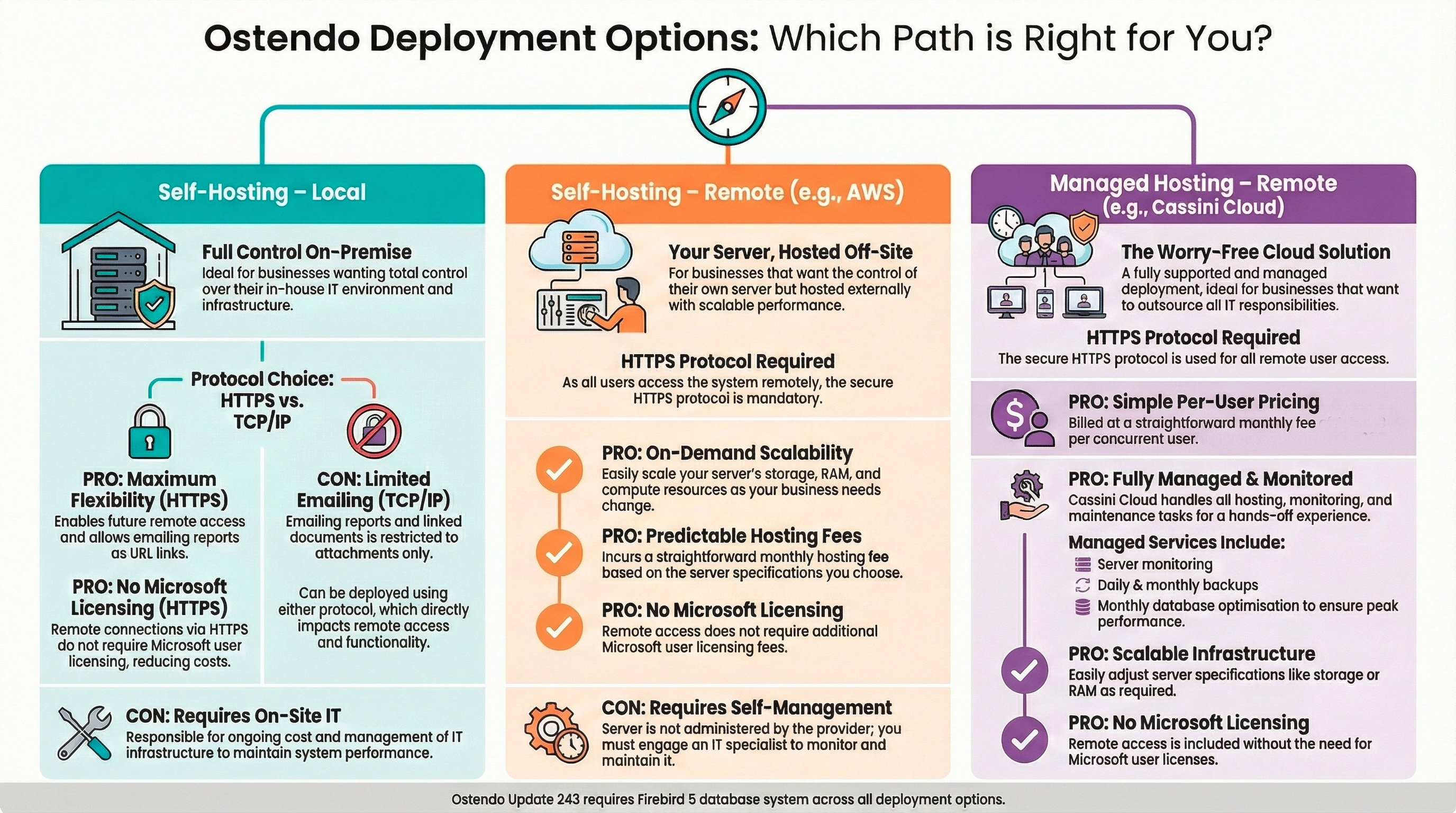
Choose Your Ideal Ostendo Deployment Model
Every business is different. Your industry, compliance obligations, IT strategy, and growth plans all influence how your ERP should be deployed. That’s why Ostendo Continuum ERP offers flexible deployment models—so your system fits your business, not the other way around.
Whether you prefer the simplicity of the cloud, the control of on-premise infrastructure, or a strategic hybrid approach, Ostendo gives you the freedom to choose—and change—when your needs evolve.
Cloud Hosted Deployment
Secure. Scalable. Simple.
Ostendo Cloud Hosted deployments are designed for organisations that want fast rollout, global accessibility, and enterprise-grade security—without sacrificing data ownership.
Unlike multi-tenanted shared environments, your Ostendo system runs on your own dedicated database instance, ensuring performance, isolation, and full data sovereignty.
Key Benefits
- Rapid deployment with minimal infrastructure overhead
- Automatic software updates to keep your system current
- Full data sovereignty—your data remains yours
- Scalable infrastructure that grows with your business
- HTTPS encrypted connections for secure access
- Your choice of data centre, including regional compliance requirements
Ideal for businesses seeking flexibility, speed, and secure remote access across multiple locations.
On-Premise Deployment
Total Control. Maximum Compliance.
For organisations with strict regulatory, security, or operational requirements, an on-premise deployment delivers complete control over your data and environment.
Ostendo installs directly on your own infrastructure, integrating seamlessly with local systems and workflows. You can still take advantage of HTTPS web-based access, allowing secure remote connections without exposing your core systems.
Key Benefits
- Complete data sovereignty
- Full control of infrastructure and environment
- Deep integration with local systems and equipment
- No dependency on internet connectivity
- Optional HTTPS encrypted connections for remote access
Ideal for compliance-driven industries or organisations that require full ownership of their IT environment.
Hybrid Deployment
The Best of Both Worlds.
A hybrid deployment combines on-premise reliability with cloud flexibility, giving you the freedom to place systems where they make the most sense.
Run critical databases locally while hosting others in the cloud. Scale when required, implement robust disaster recovery, and retain the ability to switch between deployment models if your strategy changes.
Key Benefits
- Flexible data placement across cloud and on-premise environments
- Cloud scalability on demand
- Local control for mission-critical systems
- Enhanced disaster recovery options
- A phased migration path that reduces risk and disruption
Ideal for growing businesses, multi-site operations, or organisations planning a future transition to the cloud.
Future-Proof Your ERP Deployment
With Ostendo, your deployment model is never locked in. As your business evolves, compliance requirements change, or technology strategies shift, your ERP can adapt with you.
Whether cloud, on-premise, or hybrid—Ostendo Continuum ERP puts you in control.
Ostendo runs on the Firebird SQL relational database—an industry-strength platform able to scale seamlessly to 100+ users.
(Click on the image to enlarge it)
(Click on the image to enlarge it)
Performance Benchmarking Across Local Ostendo Environments
As Ostendo continues to evolve across multiple platforms and technologies, understanding how each environment impacts system speed and scalability has become increasingly important. To provide clear insight into real-world performance, we conducted a controlled benchmarking study comparing database interaction speeds across different Ostendo versions and Firebird database engines.
This article summarises the benchmarking setup, testing methodology, and key outcomes—highlighting where the most significant performance improvements are achieved.
Test Environment Overview
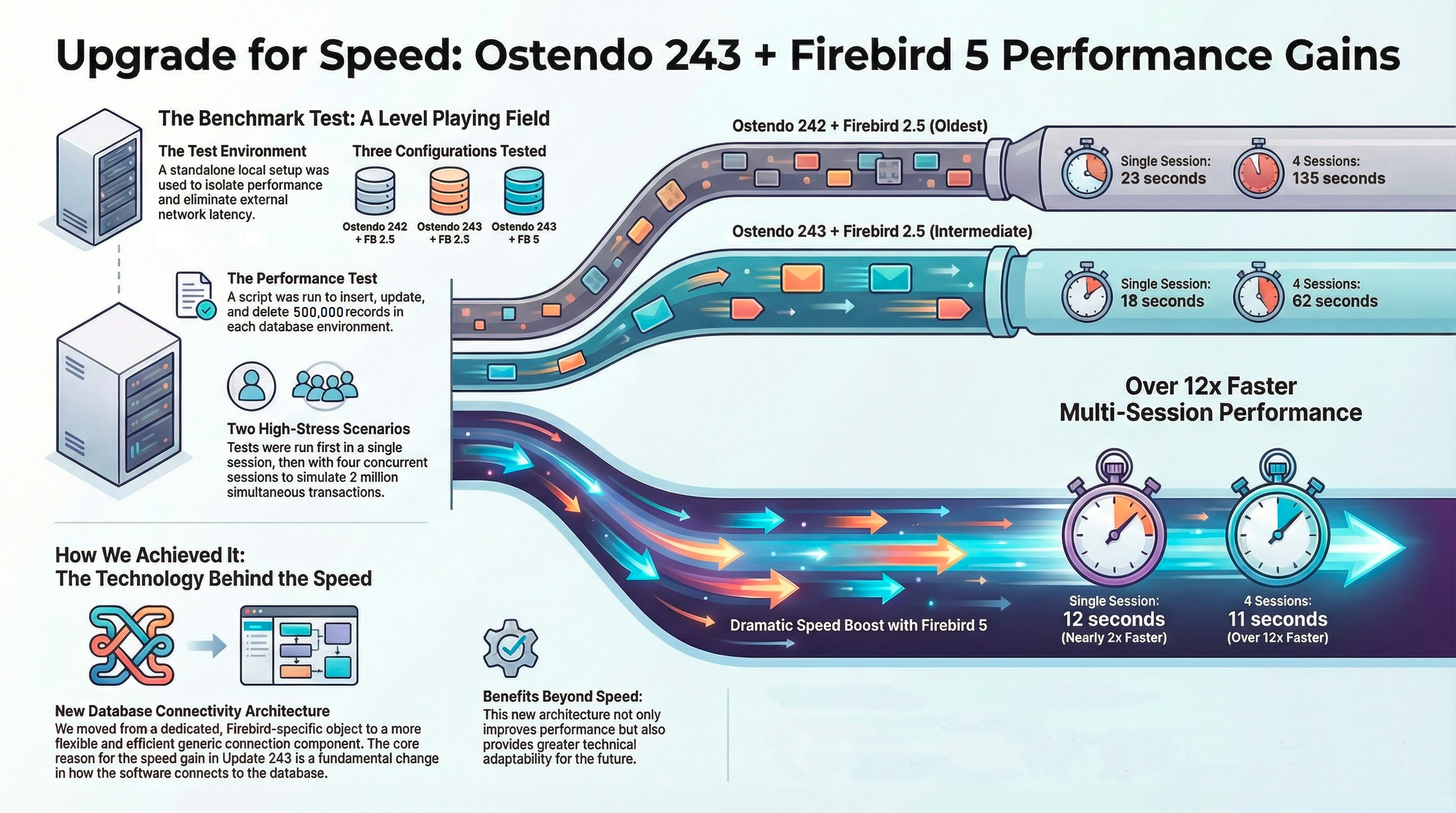
All benchmarking was performed in a standalone local environment to remove external factors such as network latency, remote hosting variance, or cloud-based delays. This ensured that the only variables influencing performance were Ostendo update level and Firebird engine version.
Three identical database copies were created to provide a like-for-like comparison:
- Database 1: Update 242 running on Firebird 2.5
- Database 2: Update 243 running on Firebird 2.5
- Database 3: Update 243 running on Firebird 5
Testing Methodology
To measure raw database interaction performance, a purpose-built script was developed to simulate heavy transactional activity. Each database was subjected to two phases of testing:
1. Single-Session Test
A single session executed a scripted process that:
- Inserted
- Updated
- Deleted
500,000 records into a dynamically generated table.
This baseline test measured isolated performance without concurrency.
2. Multi-Session Load Test
The same script was executed simultaneously across four sessions, generating:
-
2 million concurrent transactions
This phase assessed how each environment handled load, contention, and transactional throughput.
Controlled Execution
To maintain consistent conditions:
- The test workstation was rebooted between each benchmark, ensuring clean memory and engine state.
- The scripts, data structure, and execution steps were identical across all environments.
Test Results
While specific numerical results may vary depending on hardware and operating conditions, the overall trend across all benchmarks was clear and consistent.
(Click on the image to enlarge it)
Key Findings
1. Update 243 + Firebird 5 Is Significantly Faster
Across both the single-session and multi-session tests, Update 243 running on Firebird 5 demonstrated a substantial performance advantage, outperforming:
- Update 242 on Firebird 2.5
- Update 243 on Firebird 2.5
The improvement was especially noticeable under high-concurrency workloads.
2. Architectural Improvements in Update 243 Drive Better Performance
One of the major reasons for the performance jump between Update 242 and Update 243 is a significant architectural change in database connectivity.
Previously:
-
Ostendo relied on a dedicated Firebird-specific connection object, which limited optimisation and flexibility.
Now in Update 243:
- A modern, generic connection component is used across environments.
- This delivers:
- Faster data operations
- Improved scalability
- Greater adaptability for future technologies
This shift in connection architecture not only improves speed but also reduces technical constraints for ongoing development.
Conclusion
The benchmarking results confirm that upgrading to Update 243 with Firebird 5 provides a clear and measurable performance advantage—particularly for businesses running large datasets or high-volume transactional workloads.
With enhanced database connectivity and improved handling of concurrent activity, Update 243 positions Ostendo for faster, more scalable operations across modern deployment environments.