Bills of Materials & Custom Product Configuration in Ostendo Continuum ERP
(Click on the image to enlarge it)
In manufacturing and engineer-to-order environments, accurate product structures and flexible configuration are critical. Ostendo Continuum ERP delivers a powerful, fully integrated Bill of Materials (BOM) and Custom Product Configurator that supports everything from simple assemblies to highly complex, configurable products—while maintaining full cost control, traceability, and production efficiency.
Bill of Materials: The Foundation of Manufacturing
The Bill of Materials in Ostendo defines what is made, how it is made, and what it costs. It supports both discrete and process manufacturing, enabling businesses to manage standard products, custom builds, and one-off jobs within a single system.
Key BOM Capabilities
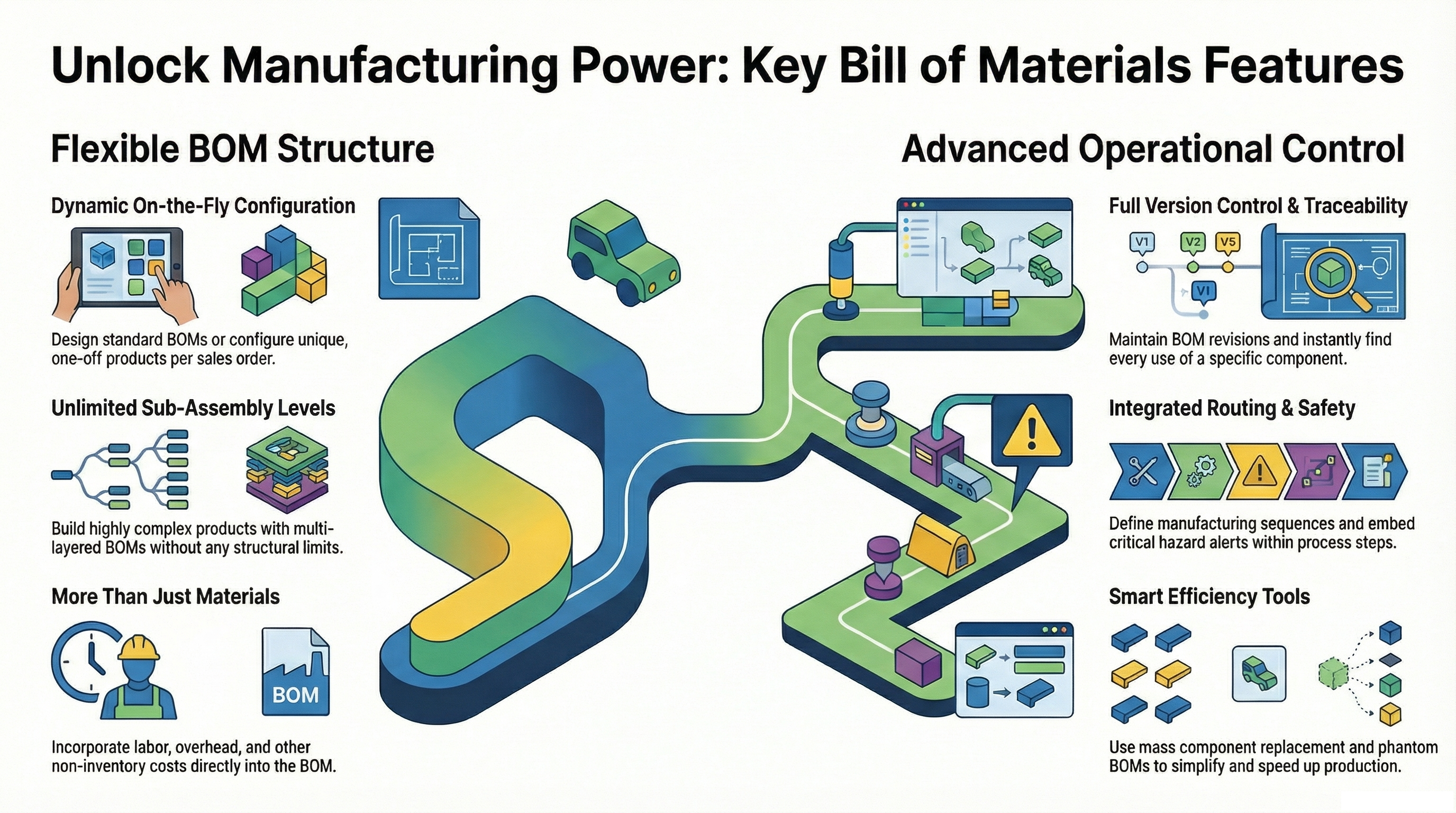
- Unlimited BOM levels with hierarchical tree view for complete product visibility
- Version control with effective dates and batch quantities for full engineering traceability
- Make-to-stock or make-to-order manufacturing models
- Phantom BOMs that automatically explode into parent orders at production time
- Co-products and by-products for process and batch manufacturing
- Optional routing steps with separate setup and run times
- Setup Usage and Cost amortised across defined quantities
- Scrap percentages, tools, auxiliary equipment, and overhead recovery
- BOM cost roll-ups with detailed costed BOM reporting
- Change reporting and full audit history
- “Where Used” inquiry for instant impact analysis
- Mass replacement to update components across multiple BOMs efficiently
Together, these capabilities allow manufacturers to manage complex product structures with confidence while maintaining cost accuracy and production control.
Complete Product Structure Visibility
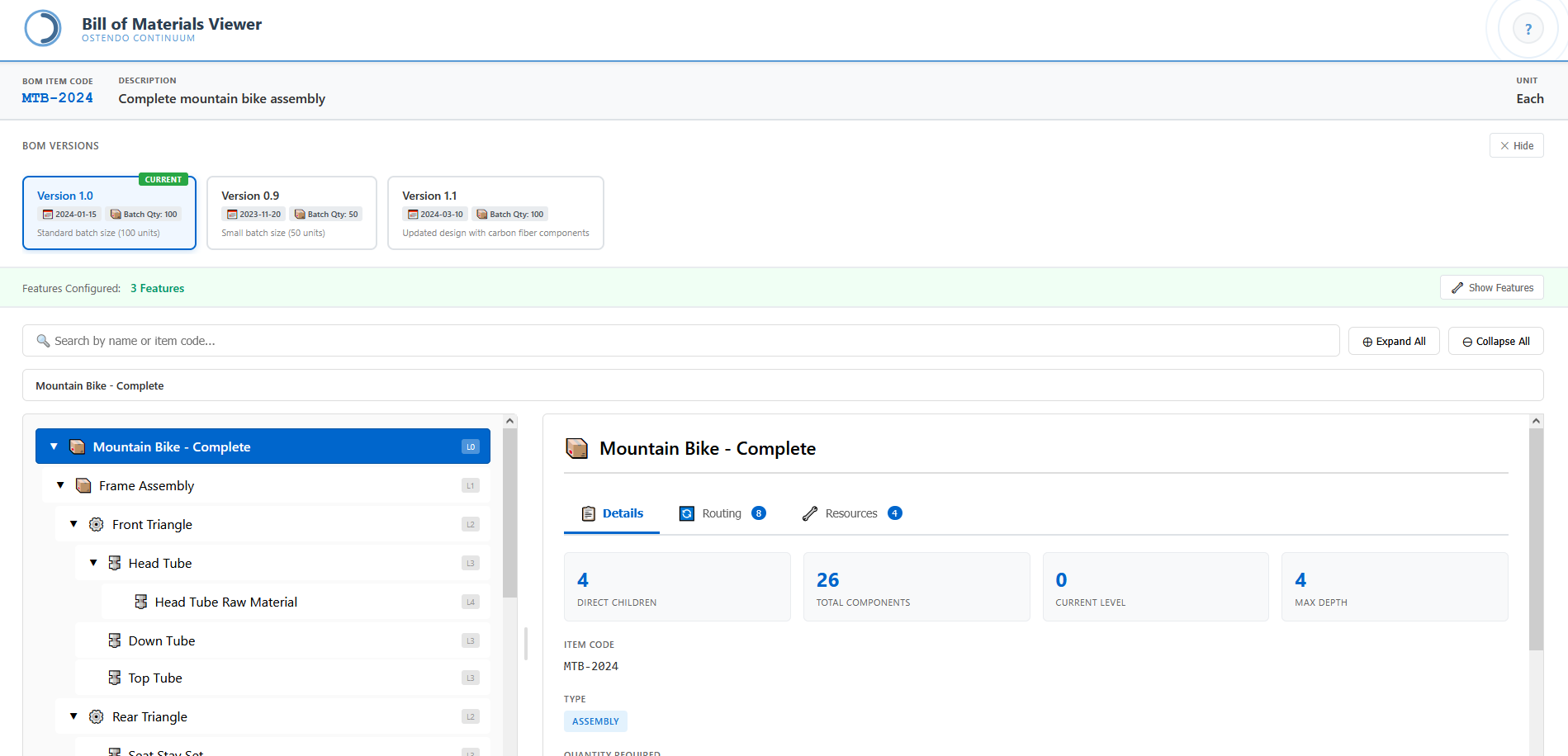
Ostendo’s BOM Viewer provides a clear, intuitive interface for exploring multi-level product structures—whether they span two levels or twenty.
Visual Tree View
- Expandable, collapsible hierarchy showing assemblies, sub-assemblies, and raw materials
- Visual indicators for item type and BOM depth
- Instant search by item code or description
Detailed BOM Insights
- Routing operations and manufacturing sequences
- Labour, machine, and tooling requirements
- Metrics such as total component count, child relationships, and maximum depth
- Side-by-side comparison of BOM versions for engineering change management
This complete visibility supports faster decision-making and improved collaboration between engineering, production, and costing teams.
(Click on the image to enlarge it)
Routing, Operations & Safety
Routing steps define how a product is manufactured:
- Logical sequencing of operations
- Assignment of work centres, resources, and machines
- Separate setup and run times for accurate scheduling and capacity planning
- Standard operating procedures (SOPs) and documentation automatically available on work orders
- Hazard identification at routing-step level, including material handling and machinery safety
By embedding routing and safety directly into the BOM, Ostendo ensures production consistency, compliance, and operator awareness.
Advanced Costing & Margin Control
Custom configurations often require different pricing strategies. Ostendo supports:
- Different costs per configuration
- Variable mark-ups or margins by component or component type
- Accurate amortisation of setup costs across defined quantities
- Full visibility of material, labour, and overhead contributions
This ensures every configured product remains profitable—without manual spreadsheets or guesswork.
Integrated Documentation & Attachments
All product knowledge can be stored directly against BOMs and components:
- Engineering drawings and CAD files
- Work instructions and SOPs
- Quality documents and inspection criteria
- Safety data sheets and handling instructions
- Reference images and photos
Documents are available exactly where they are needed—on BOMs, routing steps, and manufacturing orders—supporting quality management and compliance.
Custom Product Configurator: Build to Order with Confidence
For businesses that manufacture custom or configurable products, Ostendo’s Custom Product Configurator enables flexible, rule-driven product creation without sacrificing control or accuracy.
Configuration Methods
- Features & options based on a standard BOM
- Rules-based Q&A scripts that guide users step-by-step
- Manual configuration for complete flexibility on one-off jobs
- Configuration directly from quotes and orders for seamless sales-to-production flow
Each configuration can dynamically adjust materials, labour, routing, and costs—ensuring accurate pricing and manufacturability.
Auto-Generated BOMs
Once a custom product is configured, Ostendo can automatically generate and save a new BOM for future reuse. This allows one-off configurations to become repeatable products without re-engineering effort.
Why Use BOMs & Configurator in Ostendo Continuum ERP?
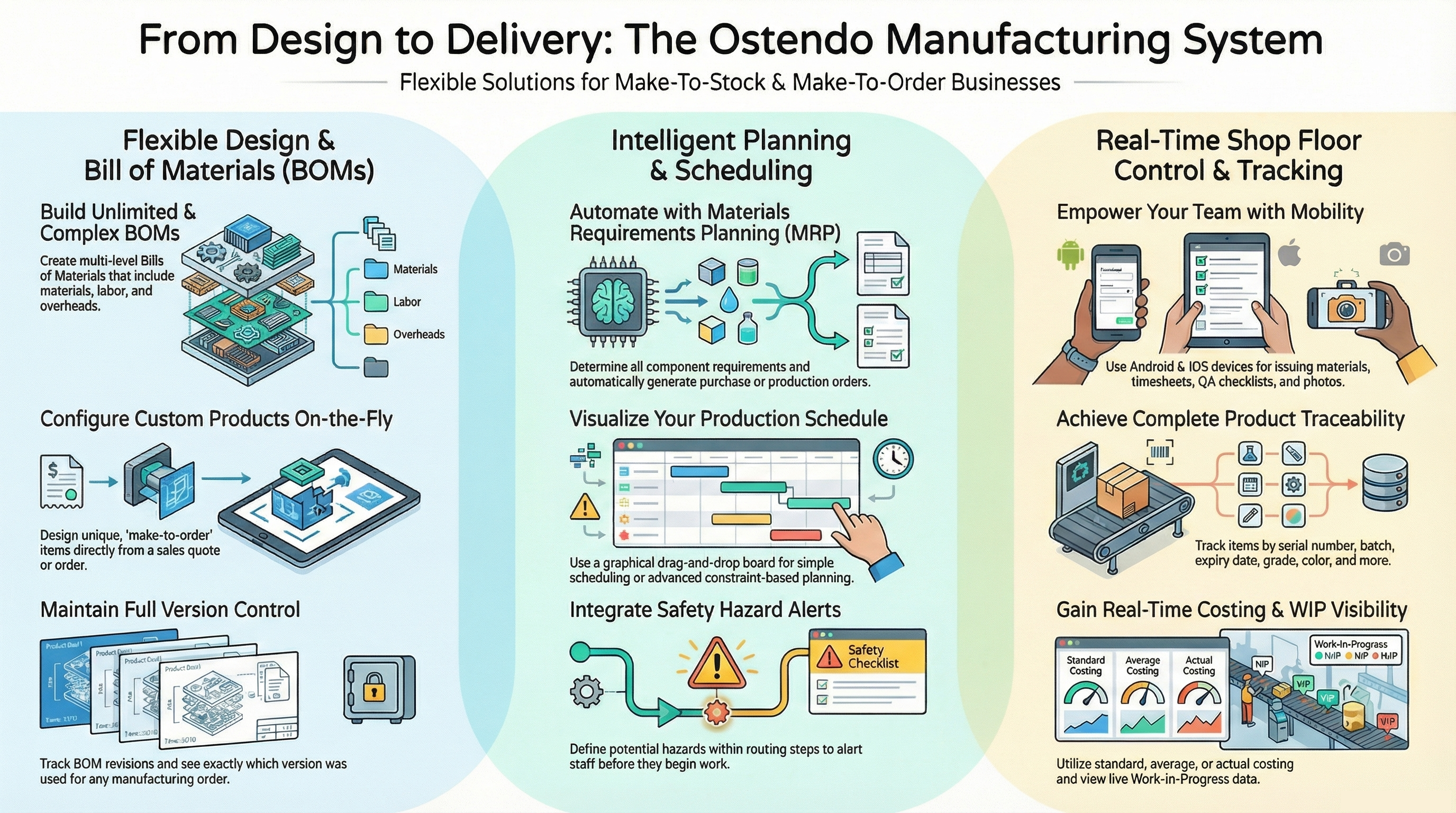
By combining deep BOM functionality with a flexible product configurator, Ostendo Continuum ERP enables manufacturers to:
- Handle complex product structures with ease
- Support engineer-to-order and make-to-order workflows
- Maintain full traceability and version control
- Improve production efficiency and safety
- Deliver accurate costing and pricing—even for custom products
Whether you manufacture standard products, configurable options, or highly customised builds, Ostendo provides a single, integrated platform to manage your entire product lifecycle—confidently and efficiently.
Ready to streamline your Bills of Materials and custom product configuration?
Talk to us to see how these capabilities can be tailored to your manufacturing environment.
(Click on the image to enlarge it)
Reporting & Analysis
Effective reporting and visibility for Bills of Materials (BOMs) and Custom Product Configuration are essential for controlling cost, complexity, and change in modern manufacturing and distribution environments. A strong reporting layer ensures engineering, sales, production, and finance all work from a single, trusted source of truth, even when products are highly configurable or made-to-order.
BOM Structure & Integrity Reporting
Gain full transparency into how products are built, from top-level assemblies down to the smallest component.
- Multi-Level BOM Explosion Reports - Visualise parent–child relationships across unlimited BOM levels, including phantom and reference components.
- Component Usage & Where-Used Analysis - Instantly identify where a part is used across standard and configured BOMs to assess impact before changes are made.
- Revision & Version Control Visibility - Track historical, current, and future BOM revisions with clear effective dates for engineering and production alignment.
- Material Substitution & Alternate Items Reporting - Report on approved alternates and substitutions to support supply continuity and engineering flexibility.
Custom Product Configuration Visibility
Ensure every configured product is accurate, manufacturable, and profitable before it reaches the shop floor.
- Configuration Rule Validation Reports - Confirm that selected options comply with engineering rules, compatibility constraints, and design standards.
- Configured BOM Comparison - Compare configured BOMs against base templates to highlight option-driven changes in components, routing, and cost.
- Option & Feature Popularity Analysis - Identify frequently selected options to guide standardisation, stocking strategies, and product development.
- Engineering-to-Order Traceability - Maintain full visibility from customer configuration through to generated BOMs, routings, and work orders.
Costing, Margin & Profitability Reporting
Understand the financial impact of every configuration choice.
- Configured Product Cost Breakdown - Detailed visibility into material, labour, overhead, and subcontract costs per configured item.
- Estimated vs Actual Cost Reporting - Compare quoted configuration costs to actual production results to refine pricing and estimating accuracy.
- Margin by Option & Variant - Identify which options drive profit and which erode margins across product families.
- What-If Configuration Scenarios - Model alternative configurations to evaluate cost, lead time, and profitability before committing.
Change Management & Engineering Control
Reduce risk by making change visible and measurable.
-
Engineering Change Impact Analysis
Assess how BOM or configuration rule changes affect existing orders, inventory, and production schedules. -
Obsolete & Superseded Component Reporting
Highlight components or options that are no longer valid to prevent production errors. -
Audit Trails & Compliance Visibility
Maintain full traceability of who changed what, when, and why—supporting ISO, customer, and regulatory audits.
Operational & Planning Insights
Align configuration complexity with operational capability.
- Configured Demand Forecasting - Analyse historical configuration trends to improve planning for materials, capacity, and skills.
- Bottleneck & Long-Lead Component Visibility - Identify components frequently triggered by configurations that constrain supply or production.
- Make-to-Order vs Make-to-Stock Analysis - Report on configuration frequency to decide which variants should become standard BOMs.
Executive Dashboards & Cross-Functional Visibility
Deliver clarity across the organisation.
- Role-Based Dashboards - Tailored views for engineering, sales, production, and finance—each focused on what matters most.
- Visual BOM Trees & Configuration Snapshots - Intuitive, drill-down views that simplify complex products for fast decision-making.
- Integrated Reporting Across ERP Modules - BOM and configuration insights seamlessly connected to sales, purchasing, manufacturing, and finance.
Outcome:
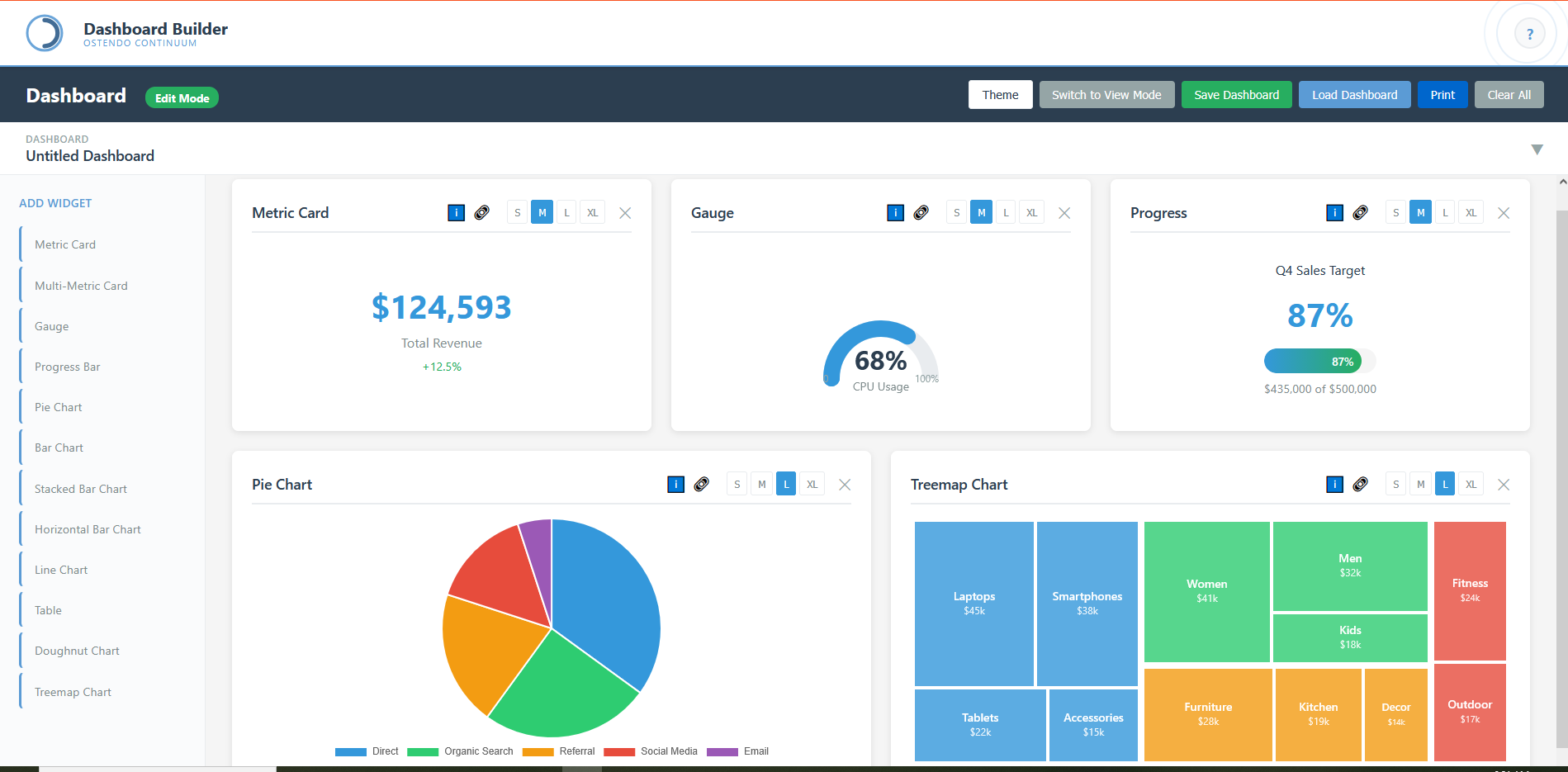
With robust reporting and visibility for BOMs and custom product configuration, organisations gain tighter engineering control, more accurate costing, faster order fulfilment, and improved profitability—without sacrificing the flexibility customers expect.
(Click on the image to enlarge it)